Talent acquisition leaders are under sharpening pressure to prove that hiring investments produce measurable business value, not just filled requisitions. That expectation is now visible in the data. The 2026 RPO Buyer Trends Study, produced by the Recruitment Process Outsourcing Association (RPOA) in partnership with Lighthouse Research and Advisory, found that 69 percent of employers report a positive return on investment from their RPO partnership and 61 percent say their hiring metrics have improved overall. At the same time, buyers increasingly value strategic guidance, AI expertise, and business alignment rather than recruiting execution alone. The question for talent leaders is no longer whether Recruitment Process Outsourcing (RPO) works, but how to select and structure a partnership that delivers outcomes the business can measure.
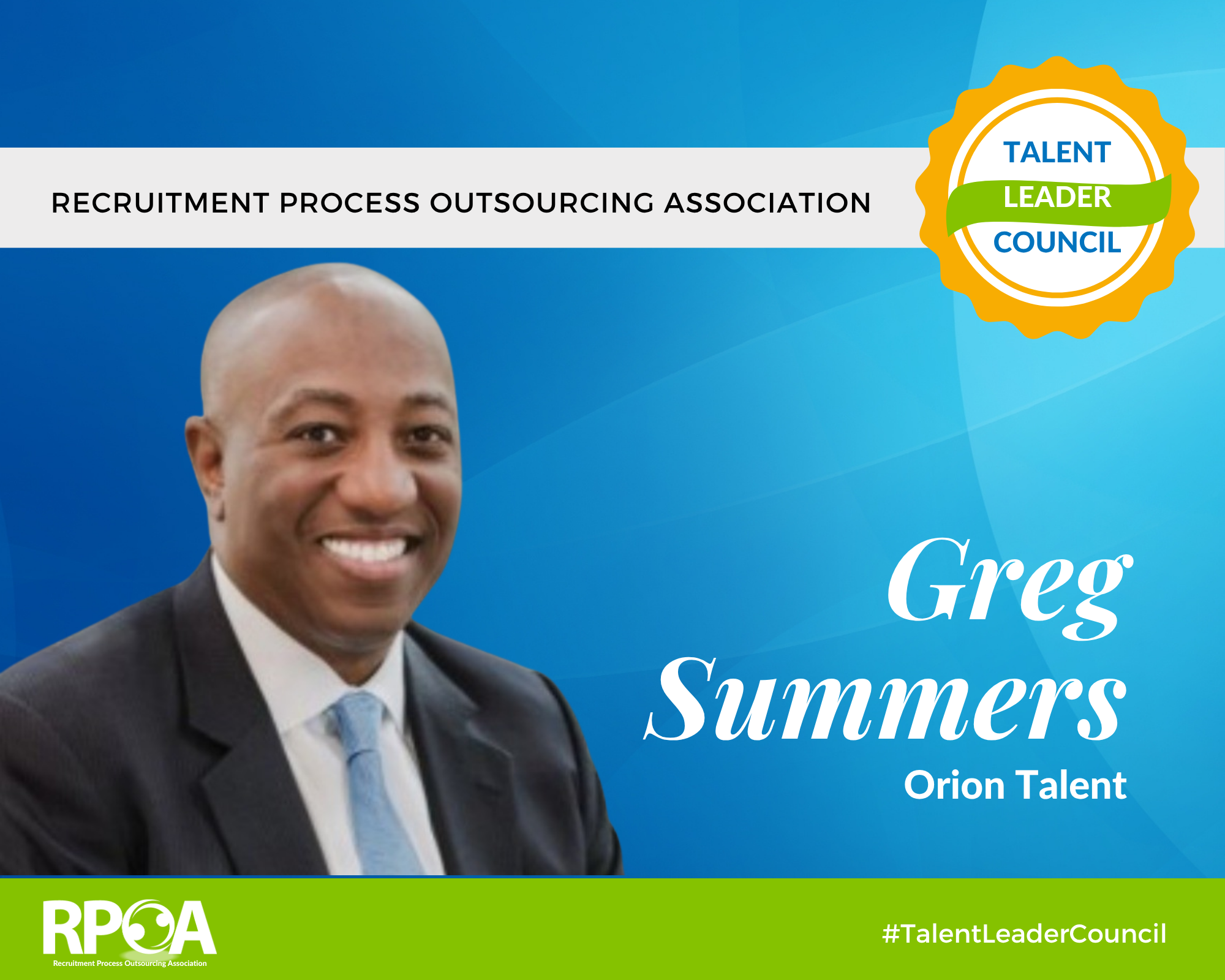
This article is based on an edited version of a recorded interview with Greg Summers, Chief Executive Officer at Orion Talent, a founding member of the RPOA. It is part of the RPOA Talent Leader Council interview series, a program that convenes senior practitioners to interpret market shifts for talent acquisition leaders. The interview was conducted by Lamees Abourahma, CEO at the RPOA.
Key Takeaways for Talent Acquisition Leaders
- Redefine how you measure RPO value. Move beyond time to fill and quantify strategic returns such as recruiter hours returned to the internal team, faster time to productivity, and alignment between hiring and business goals.
- Treat hiring constraints as business constraints. When talent scarcity threatens growth, expect an RPO partner to inform workforce planning, site selection, and relocation strategy, not only sourcing.
- Push the relationship from strategic to transformational. Strategic conversations identify the right direction; transformational partnerships secure stakeholder approval to act. Build governance that converts recommendations into decisions.
- Layer AI deliberately, not aggressively. Use AI to expand candidate coverage and analyze transferable skills at scale, while preserving human recruiters for the judgment-intensive, life-changing moments of the hiring process.
- Use partnership maturity as a planning input. Partnership maturity will develop over time, but organizations can accelerate it through strong governance, business alignment, and early stakeholder involvement.
From Cost and Speed to Strategic Workforce Value
For most of the industry's history, RPO buyers evaluated partners on cost, speed, and quality, with scalability added as demand volatility rose after 2015. Those measures still matter, but the 2026 RPO Buyer Trends Study shows expectations have widened toward business alignment and strategic guidance. Understanding how a seasoned operator defines success today helps leaders calibrate what to ask for.
RPOA: How has the definition of a successful RPO changed over the past five years, and what does that mean for how buyers should evaluate value?
Greg Summers: When I entered this space around 2002, the conversation was first about cost, then speed and quality. Between 2015 and 2020, scalability became a major requirement, and those four factors are still important. What has changed since the pandemic is that most organizations are no longer looking only for speed, cost, quality, and scalability. They want a partner that can help them, from a strategic perspective, figure out how to manage a workforce plan. That has become more important now that AI is reshaping roles. Companies that will not be hiring the same people tomorrow that they hired yesterday need a partner who can read the market, understand which transferable skills apply to the roles they need, and build a plan to bring that talent into the business.
For talent leaders, the operating implication is a shift in evaluation criteria. Return on investment increasingly rests on outcomes that are harder to see on a scorecard but more consequential to the business.
RPOA: What does ROI actually mean in a mature RPO relationship, beyond traditional efficiency metrics?
Greg Summers: Traditionally people asked whether you could hire faster, using time to fill as the metric. That still matters, but for more strategic organizations, and many have been in RPO partnerships for a decade or more, ROI looks different. They are asking whether you are giving their hiring team time back, whether you carry the recruiting process more effectively because you understand their roles and their culture, and whether their team can step back because you have it handled. For organizations that use us for onboarding, they ask whether we help new talent reach productivity faster. Those are the outcomes with real business impact, and those are what strategic buyers want to measure.
“Are you giving my hiring team time back, and helping new talent reach productivity faster? Those are the things that have real business impact.” Greg Summers, CEO, Orion Talent
Business Problems Are Talent Problems
The clearest signal of RPO's shift from efficiency to impact is its role in solving enterprise challenges that begin as hiring shortages. The demand strain is acute in infrastructure-intensive sectors. In AI data center construction alone, the U.S. Bureau of Labor Statistics projects the need for nearly 400,000 more construction workers by 2033, with the largest gaps in power infrastructure and electricians, according to reporting by IEEE Spectrum. When specialized talent cannot be found where facilities are located, the constraint becomes strategic.
RPOA: Can you share an example where your organization helped a client solve a broader business challenge rather than simply filling positions?
Greg Summers: The reality is that business problems are talent problems. A lot of our work in the digital and data center space involves finding commissioning agents and electrical and HVAC technicians. If clients cannot find that talent, they cannot keep pace with the hyperscalers, and time to bring centers online becomes a critical business risk. In aerospace and shipbuilding, we have seen clients who cannot find the talent in the markets where their facilities sit. So a bigger part of the work is helping them build a plan to relocate talent to where the facilities are, and also helping them identify locations for satellite offices in talent-dense environments, so they do not have to move everyone to their primary plant. We have done that successfully in those industries, and I expect it will spill over into others as talent becomes more scarce.
This reframes the RPO mandate. Site selection, relocation planning, and labor market intelligence move into scope, and talent leaders should expect their partners to contribute to decisions that were once confined to operations and real estate. The study reinforces the point: buyers now prize alignment between hiring and business outcomes, because the underlying issue is rarely just a hiring problem.
Moving the Partnership from Strategic to Transformational
The 2026 RPO Buyer Trends Study describes a maturity spectrum, with roughly half of buyers classifying their RPO relationship as strategic and the remainder split between transactional and transformational engagements. The distinction is not academic. It determines whether an RPO partner shapes decisions or simply executes them.
RPOA: What separates a strategic RPO relationship from a transformational one, and how should leaders think about that progression?
Greg Summers: In my experience, it tends to align with how long an organization has worked with an RPO partner. The longer the relationship, the more likely they are to sit in that strategic bucket, meeting quarterly or annually to discuss what is happening in the business and how it will affect the talent they need. The difference between strategic and transformational is this: in a strategic relationship, you are having discussions about what needs to be done. In a transformational relationship, you are working together with stakeholders to actually get approval to move forward and do that work. It is one thing to agree on the direction. Being able to secure approval to move down that path is what makes the real difference. We are seeing it play out now as organizations come to us for support transforming their workforce processes with AI. The strategic questions are how, where, and with whom. Getting the approval to move forward is what pushes it into the transformational category.
For leaders, the actionable insight is governance. Reaching transformational value requires internal structures that turn a partner's recommendations into funded, approved initiatives. Relationship tenure is a useful planning input, but organizations can accelerate maturity by involving stakeholders with decision authority earlier in the partnership.
“In a strategic relationship you discuss what needs to be done. In a transformational one, you get approval to actually do it.” Greg Summers, CEO, Orion Talent
Layering AI Deliberately While Protecting the Human Core
No workforce conversation now avoids AI, and the pressure to adopt it can outrun sound judgment. The World Economic Forum Future of Jobs Report 2025 finds that nearly 40 percent of the skills required on the job will change by 2030, and concludes that AI's primary near-term effect is to augment human work through collaboration rather than replace it outright. That framing matches how disciplined RPO providers are deploying the technology.
RPOA: Where are we in the AI transition, and how should talent leaders approach adoption without overreaching?
Greg Summers: With new technology, there is always an expectation that the result will be far greater than it turns out to be in the short term. We are just past that early phase, and people are recognizing that you still need recruiters, you still need people in HR, and you still need people to perform core functions. Organizations are moderating their short-term expectations and getting back to figuring out how to apply AI appropriately rather than aggressively across everything. As a practical example, we brought online a voice and video enabled agent named Juliet to run initial screens with people who apply or register on our website. Before Juliet, we could not get to everyone. Now everyone who comes to us hears that we see them and want to learn more about what they are looking for. But we deliberately set up a co-working model so our recruiters benefit from the screening and information Juliet surfaces, because our recruiters bring expertise that AI will not. The goal is to layer AI in strategically, not to overlay it without thinking through the outcome.
Summers draws a firm line around the moments where human judgment is not optional. That line clarifies where leaders should invest in people even as they automate.
RPOA: With capable technology available, why is the human recruiter still essential to the RPO value proposition?
Greg Summers: Every day our recruiters talk with people who are changing careers, and in our military recruiting work, transitioning out of the service after years away from the civilian workforce. These are decisions that affect people, their lives, and in some cases their families. I do not think people will make those decisions without a conversation with a human who understands the culture, the organization, and even the team they would join. If you are helping someone make a life-changing decision, they are better served by a person who understands the emotional weight of it, not just the tactical details. Where AI becomes a genuine advantage is in analyzing large data sets to surface transferable skills that are not captured on a resume. That is not something a team of recruiters can do alone, and it is exactly where the technology strengthens what recruiters do.
“Technology is an enabler, not the primary decision maker. People making life-changing decisions are better served by a human who understands the emotional weight of the choice.” Greg Summers, CEO, Orion Talent
The leadership takeaway is a division of labor. AI should expand reach and analytical depth, particularly for skills-based hiring in changing workforces, while human recruiters own the relationship, cultural insight, and guidance that influence whether a candidate accepts and succeeds. Treating technology as an enabler rather than a replacement protects both candidate experience and hiring quality.
Conclusion
The shift from efficiency to impact is not a matter of rebranding recruiting activity. It reflects a genuine change in what employers need and what they are willing to reward. Talent scarcity in critical sectors, the reordering of skills, and the disciplined integration of AI have collectively raised the bar: an RPO partnership now earns its value by informing workforce strategy, delivery models, and governance, not by filling seats. Leaders should respond by broadening how they define and measure ROI, building governance that turns strategic counsel into approved action, and adopting AI in a way that augments rather than displaces the human judgment at the center of hiring. As an evidence-driven convener of the RPO ecosystem, the RPOA continues to document these shifts so that buyers and providers alike can make sound, informed decisions about the future of talent acquisition.