Global hiring has entered a paradoxical phase. Overall job growth has moderated compared to the post-pandemic surge, yet competition for specialized skills remains intense. According to the World Economic Forum’s Future of Jobs Report 2023, nearly half of employers expect technology adoption to transform core roles within five years, accelerating demand for advanced digital and technical capabilities. At the same time, McKinsey & Company has reported persistent talent shortages in critical functions such as engineering, advanced manufacturing, and healthcare operations.
In this environment, recruitment leaders are navigating cooling hiring volumes, geopolitical volatility, and artificial intelligence disruption simultaneously. The implications for Recruitment Process Outsourcing (RPO) strategy are significant.
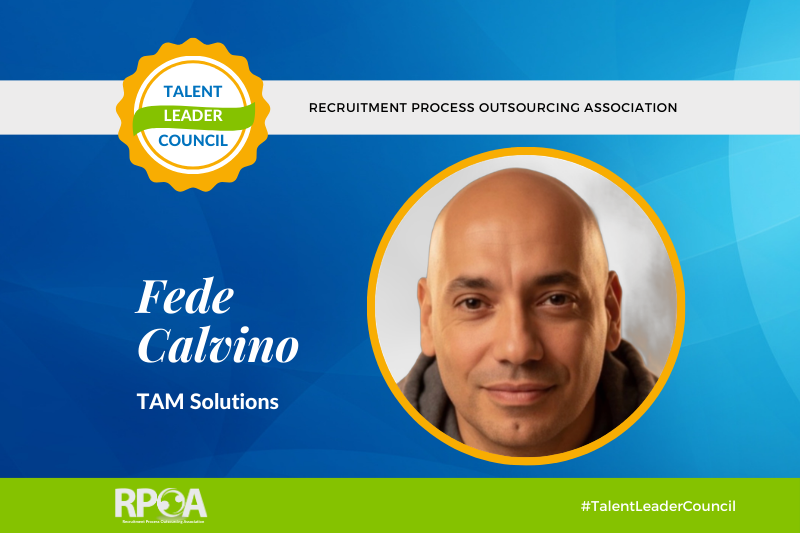
This article is based on an edited interview with Federico (Fede) Calvino, Co-Founder and Chief Strategy Officer at TAM Solutions and a Talent Leader Council contributor. The conversation is part of the Talent Leader Council interview series conducted by Lamees Abourahma, CEO of the Recruitment Process Outsourcing Association.
Key Takeaways for Talent Acquisition Leaders
- Recalibrate value propositions in Recruitment Process Outsourcing to reflect scarcity in specialized skills, not overall hiring volume.
- Incorporate geopolitical risk analysis into workforce planning and RPO delivery models.
- Invest in AI capabilities that augment recruiter effectiveness rather than replace strategic judgment.
- Expand global talent sourcing strategies to mitigate localized skill shortages and market volatility.
- Reassess employer branding strategies in light of global instability and candidate risk sensitivity.
The Market Has Cooled, but Skill Scarcity Has Not
Even as hiring activity normalizes from the 2021 peak, structural shortages remain in manufacturing, engineering, and healthcare. The U.S. Bureau of Labor Statistics continues to project long-term growth in healthcare occupations through 2032, while advanced manufacturing faces persistent skills gaps tied to automation and reshoring trends.
For Recruitment Process Outsourcing providers and enterprise talent leaders, this creates a strategic tension. Lower hiring volumes increase competition among service providers, yet specialized roles demand greater sophistication in sourcing and delivery.
RPOA: When overall hiring slows but demand for specialized skills intensifies, what shifts for talent acquisition leaders?
Calvino: Market dynamics force service providers to become more creative and disciplined in how they deliver value. In 2021, demand outpaced supply across nearly every function. Today, there is less aggregate hiring demand, but very specific roles remain extremely difficult to fill. That requires a different operational model.
Calvino emphasized that many RPO firms are now “fighting for the same clients,” a reflection of reduced volume but heightened competition. For enterprise leaders, this means evaluating Recruitment Process Outsourcing partners not only on scalability but on niche capability depth.
“The market dynamic forces you to rethink service delivery,” said Calvino, Co-Founder and CSO at TAMS Solutions. “There is much less demand compared to 2021, but the scarcity in certain skill sets has not gone away.”
The implication for leaders is clear. Success depends less on throughput and more on precision targeting of high-impact roles.
Geopolitics Is Now a Talent Variable
Workforce strategy can no longer be separated from geopolitical context. Inflation, civil unrest, regulatory shifts, and cross border tensions influence investment decisions, hiring confidence, and talent mobility.
The World Economic Forum has identified geopolitical fragmentation as a top macroeconomic risk shaping labor markets through 2027. Capital allocation decisions are increasingly cautious, particularly in emerging markets and high volatility regions.
RPOA: How does the current geopolitical environment affect Recruitment Process Outsourcing and talent strategy?
Calvino: Geopolitics has a direct effect on recruiting services. Large enterprises and private investors become more hesitant to inject capital into uncertain markets. That caution impacts hiring plans, expansion decisions, and workforce investment.
Calvino brings a unique dual perspective, having lived and worked in both the United States and Latin America. He noted that market instability is not new in some regions, but it is becoming more visible in traditionally stable markets.
“Geopolitics took the whole thing and added another layer of complexity,” Calvino said. “When investors hesitate, it directly impacts hiring and recruiting services.”
For talent leaders, this underscores the need to integrate geopolitical analysis into workforce planning. Location strategy, nearshoring decisions, and global sourcing models must account for political and economic volatility.
Recruitment Process Outsourcing providers with international delivery capabilities may offer risk diversification, but only if governance models are aligned and communication is transparent.
AI Disruption Is Redefining the Recruiting Function
Artificial intelligence is transforming not only the roles companies are hiring for, but also the mechanics of hiring itself. McKinsey estimates that generative AI could automate up to 30 percent of current work hours across the U.S. economy, reshaping both job design and recruitment workflows.
For Recruitment Process Outsourcing providers, AI introduces both opportunity and disruption.
RPOA: How is artificial intelligence changing recruitment strategy in this environment?
Calvino: AI is another disruptive layer on top of an already complex market. It changes how we source, screen, and engage talent. At the same time, it raises questions about long-term role evolution and skill demand.
Following the pandemic-driven hiring surge, many recruiting teams scaled rapidly. AI now challenges those operating models by automating aspects of sourcing, assessment, and communication.
For talent leaders, the decision is not whether to adopt AI, but how to do so responsibly. Automation may increase efficiency, but strategic judgment, candidate experience, and employer brand positioning remain human-led functions.
“We went from an intense bull market right after the pandemic to geopolitics and AI disruption almost overnight,” Calvino said. “It is such a unique time for recruiting.”
The leadership imperative is to deploy AI in Recruitment Process Outsourcing engagements in ways that enhance productivity while protecting governance, compliance, and candidate trust.
From U.S. Focus to Global Perspective
Historically, much industry dialogue has centered on U.S. labor market conditions. However, globalization, remote work, and digital collaboration are shifting that lens.
The Organisation for Economic Co-operation and Development has highlighted growing cross-border labor mobility and digital workforce integration. As organizations diversify talent pipelines, geographic boundaries matter less operationally but more strategically.
RPOA: Should talent leaders move toward a more global workforce strategy in this climate?
Calvino: Expanding the conversation globally allows organizations to share similar experiences across markets. Inflation, civil unrest, and economic shifts are no longer isolated phenomena. They affect workforce decisions everywhere.
Calvino noted that regions accustomed to volatility may offer lessons in resilience and adaptability. For Recruitment Process Outsourcing providers, global expansion introduces new compliance, cultural, and operational considerations.
For enterprise leaders, global strategy must be paired with risk management frameworks. Talent mobility policies, compensation benchmarking, and data security governance require heightened oversight.
The shift toward a global lens is not simply geographic expansion. It represents a broader strategic recalibration of where and how critical skills are sourced.
Leadership Implications for the RPO Ecosystem
Taken together, these forces redefine the value proposition of Recruitment Process Outsourcing.
Cooling hiring volumes increase pricing pressure and competitive intensity among providers. Skill scarcity requires specialization. Geopolitics demands risk awareness. Artificial intelligence reshapes delivery models. Globalization expands the playing field.
For talent acquisition leaders, this means:
- Prioritizing depth in hard-to-fill roles rather than broad-based volume management.
- Evaluating RPO partners for geopolitical literacy and global capability.
- Embedding AI governance into recruitment workflows.
- Reframing employer branding to address candidate concerns about stability and long-term opportunity.
Calvino’s perspective reflects a broader shift in the industry. Recruitment Process Outsourcing is no longer primarily about scalability. It is about strategic adaptability.
Conclusion: Strategic Agility in an Era of Complexity
The convergence of cooling markets, specialized skill shortages, geopolitical volatility, and artificial intelligence disruption marks one of the most complex hiring environments in recent history.
For talent acquisition leaders, incremental adjustments will not suffice. Workforce strategy must integrate macroeconomic awareness, technology adoption, and global sourcing discipline.
As the Recruitment Process Outsourcing Association continues to convene industry leaders through the Talent Leader Council, these conversations play a critical role in advancing shared understanding. By examining how experienced practitioners interpret current dynamics, the RPO ecosystem can evolve with foresight rather than reaction.
In this environment, strategic agility is not optional. It is the defining capability of effective talent leadership.