Most mid-market leadership teams ask, "Should we outsource recruiting?" The better question is "What operating model fits how we hire, and what do we need recruiting to be?" Recruitment Process Outsourcing (RPO) is one answer to that question. It is not the question.
I've spent more than 30 years in talent leadership, much of it running talent acquisition for Fortune 150-scale organizations including US Foods, PG&E, Kerry Group, Sara Lee and GE Healthcare IT. That meant leading teams of 140+ recruiters, executing 16,000+ hires a year, and taking more than $7M out of recruiting costs. Today, through Chicago Recruiting Forum and my work on the RPOA AI Impact & Innovation Taskforce, I see the same pattern from the other side of the table. Companies pick a model because a peer did, or because a provider pitched well. They do not pick it because they diagnosed their own hiring.
The operating model decides who owns the candidate experience, where hiring knowledge lives, and how fast you can flex. It also decides what you pay for when demand drops. Get it wrong, and you rarely find out in the first quarter. You find out in year two, when the contract, the costs, and the hiring results no longer line up.
What RPO promises, and what buyers report
RPO is a real and growing market, but the headline numbers hide a more mixed buyer experience. Analysts size the broad market at roughly $11 billion in 2025, growing near 9–15% a year (GMI; IMARC). Everest Group's narrower view is less rosy. It reports the market declined again in 2024 as hiring volumes fell and buyers tightened budgets.
The classic sales case is cost. RPO buyers have long been told to expect 30–50% savings, and first-generation buyers often see them (SHRM HR Magazine). The benchmark they are compared against is SHRM's 2025 average of $5,475 per non-executive hire and $35,879 per executive hire (SHRM via Pin).
The RPOA's 2026 Buyer Trends Report, the largest buyer study to date (998 employers, 454 active RPO users), shows where the model delivers and where it strains (RPOA):
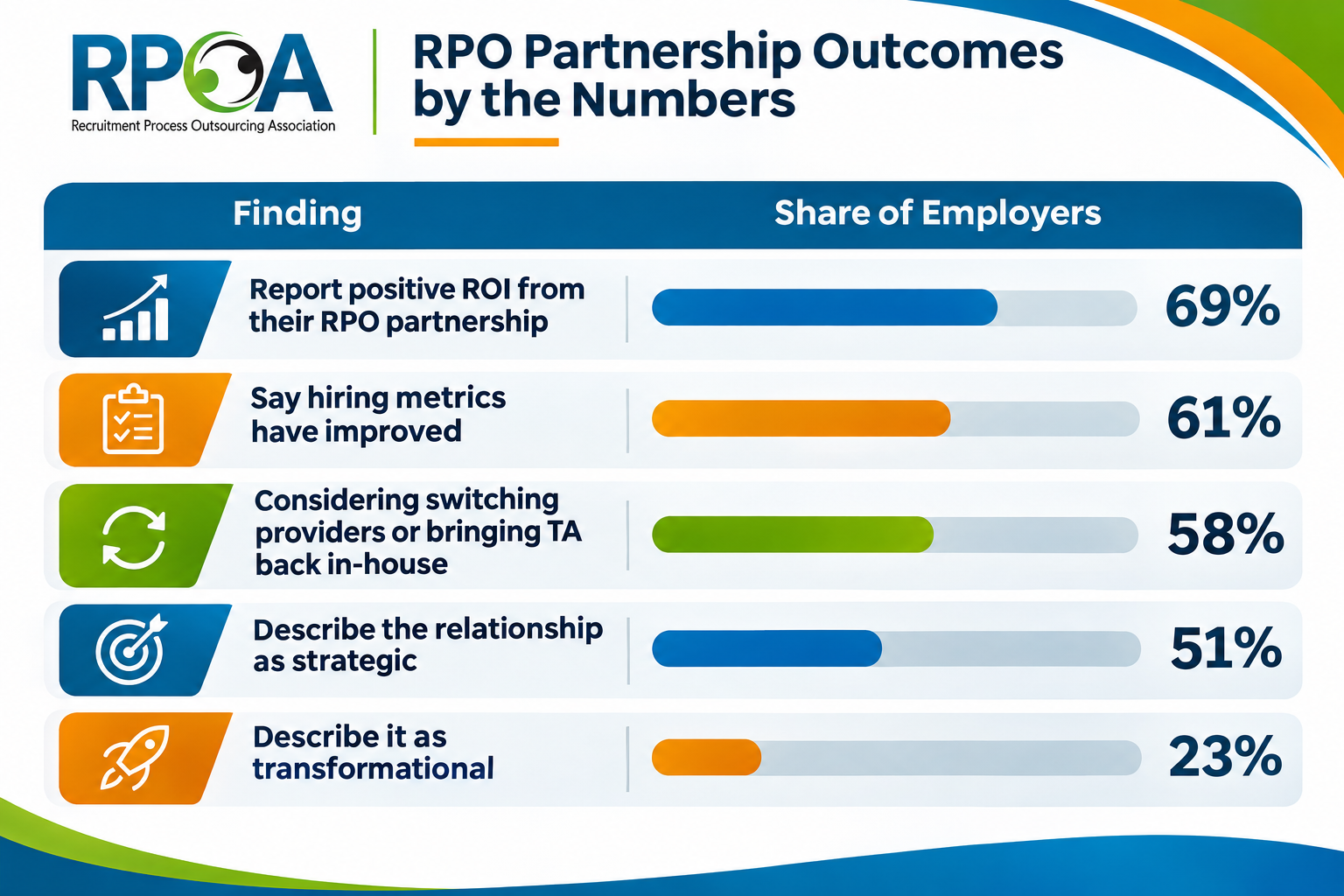
Read those together and the story is clear. Most buyers get a return, yet more than half are weighing a change. Transformational partnerships are 33% more likely to report better hiring metrics. Transactional ones are 42% more likely to report unclear or negative ROI. The model works. The fit and the way it is run decide whether it works for you.
The operating model menu
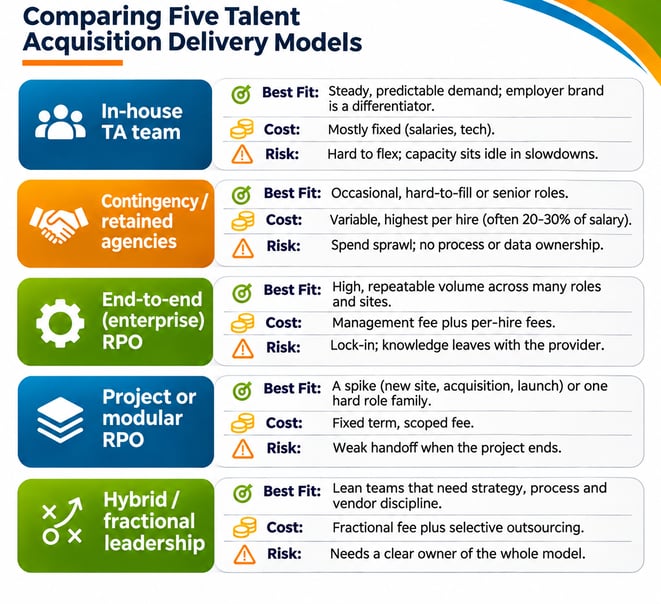
There are at least five ways to run recruiting, and most healthy mid-market functions end up blending two or three. Everest Group notes buyers now want modular and project-based RPO constructs that flex in uncertain times, not only enterprise-wide deals (Everest Group).
In-house TA team: Best suited for organizations with steady, predictable hiring demand where employer branding is a competitive advantage. Costs are primarily fixed, including salaries and technology. The main risk is limited flexibility, with excess recruiting capacity during hiring slowdowns.
Contingency / Retained Agencies: Ideal for occasional, hard-to-fill, or senior-level positions. Costs are variable and typically higher per hire, often reaching 20–30% of salary. The primary risks are fragmented spending and limited ownership of recruiting processes and data.
End-to-End (Enterprise) RPO: Best suited for organizations with high-volume, recurring hiring needs across multiple roles and locations. Pricing typically combines management fees with per-hire charges. The main risks are provider dependency and potential loss of institutional knowledge when the partnership ends.
Project or Modular RPO: Ideal for temporary hiring surges, such as new locations, acquisitions, product launches, or specialized talent needs. Costs are generally based on fixed-term, scoped agreements. The primary risk is inadequate knowledge transfer and transition planning when the project concludes.
Hybrid / Fractional Leadership: Best suited for lean talent acquisition teams requiring strategic guidance, process improvement, and vendor management. Costs combine fractional leadership fees with selective outsourcing. The main risk is unclear accountability without a designated owner overseeing the entire talent acquisition model.
The agency fee range is a common market norm, not a survey figure. Treat it as a planning assumption and check it against your own invoices.
What Fortune 150 scale and the RPOA taught me
Recruitment process outsourcing succeeds when the buyer stays in charge of the strategy and fails when outsourcing becomes abdication. That is the most consistent lesson from my enterprise years, and the RPOA data now backs it up.
1. Volume is a prerequisite, not a strategy. At 16,000+ hires a year, the economics of a dedicated provider team, shared technology, and standard workflows are obvious. Below a few hundred hires a year, the fixed cost of the governance layer can eat the savings. Scale makes RPO viable. It does not make it right.
2. You cannot outsource what you have not defined. The engagements that struggled had fuzzy job architecture, untrained hiring managers, and no agreed definition of quality of hire. A provider will run your process faster. It will not fix a broken one for you. The RPOA's finding that transactional relationships are far more likely to report unclear ROI is the same lesson in numbers (RPOA).
3. Governance is a job, not a meeting. In every large program I ran, someone internal owned the scorecard, the SLAs, and the hiring-manager relationship. When that person was missing, the provider filled the gap with its own priorities.
4. Buyers leave over capability, not price. RPOA buyers who are reevaluating cite technology and automation (39%), quality of support (38%) and provider knowledge (33%) as their top reasons (RPOA). Everest Group sees the same shift: buyers want consultative guidance and workforce insight, not only requisition throughput (Everest Group).
5. AI changes the math, and the risk. More than 75% of employers say AI has reduced recruiter workload, yet only about 30% are confident they can measure its ROI. Meanwhile, 64% encounter candidate misrepresentation at least occasionally (RPOA). My work on the RPOA AI Impact & Innovation Taskforce keeps returning to one point. If a small in-house team with good AI tools can now do what used to take a provider's bench, the case for full outsourcing has to be re-proven, not assumed.
The mid-market reality
For most mid-market companies, full enterprise RPO is the exception. A targeted, blended model is the rule. The reason is arithmetic and leverage, not ambition.
The arithmetic. Take a company making 150 non-executive hires a year at SHRM's $5,475 average (SHRM via Pin). Total spend is about $820,000. A 30% saving is roughly $245,000 a year. That is before you subtract the internal owner, transition cost, and the provider's management fee. It is real money, but it is not a transformation. Run the same math on your own volume and costs before you take a meeting. These figures are illustrative only.
The capacity question. SHRM finds most organizations run about 20 open requisitions per recruiter, and time to fill still averages about a month and a half (SHRM). Many mid-market teams are not short on recruiters. They are short on process discipline, hiring-manager accountability, and data. Outsourcing those gaps moves them; it does not close them.
The leverage problem. Large buyers get dedicated teams, named delivery leaders, and real SLA penalties. A mid-market account is often served from a shared pool. Know which one you are buying.
Where RPO does fit the mid-market:
- A defined spike: a new facility, an acquisition integration, or a product launch with a fixed hiring window.
- One high-volume role family (e.g., hourly, sales, nursing, drivers) that swamps a small team.
- Agency spend above roughly a third of the recruiting budget, where a project RPO can replace contingency fees
- A talent acquisition (TA) function with no leader, where fractional leadership plus a scoped provider beats a full outsourcing contract.
Actionable insights for mid-market leaders
RPO is sometimes the answer, but only after you have done the diagnosis. Five moves to make before you sign anything:
- Baseline before you buy. Calculate your true cost per hire, time to fill, agency spend, and hiring-manager satisfaction using the SHRM/ANSI method. Without a baseline, you can’t test a provider's savings claim.
- Segment your hiring. Split roles into high-volume, repeatable, specialized, and leadership. Each segment may need a different model. One contract for everything is rarely the best fit.
- Fix the process you would hand over. Define job architecture, interview standards, and what "quality of hire" means for you. A provider scales your process, good or bad.
- Keep strategy in-house, even if execution goes out. Name an internal owner for the scorecard, SLAs, and hiring-manager relationships. The RPOA data shows the gap between transactional and transformational partnerships is where ROI is won or lost.
- Write flexibility and AI into the contract. Favor modular or project scopes, 12- to 24-month terms with clear exit and data-ownership terms, and require the provider to show its AI tools, fraud controls, and how it measures its ROI.
The right operating model is the one you can explain in one sentence: who owns hiring, what you buy outside, and why. If you can't write that sentence yet, start with an assessment, not an RFP (request for proposal).
About the Author
Ravi Subramanian is the Founder and President of Chicago Recruiting Forum, Inc., a
boutique talent acquisition consulting firm specializing in recruiting optimization and
AI-powered transformation. With over 20 years of Fortune 150 experience managing talent
acquisition operations at scale, he helps mid-market companies access enterprise-level
recruiting capabilities through strategic consulting and technology implementation. Ravi
Subramanian is also a member of the RPOA AI Impact and Innovation Taskforce.