Artificial intelligence is rapidly reshaping talent acquisition, but adoption is proving more complex than anticipated. According to the 2026 RPO Buyer Trends Study, conducted by Lighthouse Research & Advisory and commissioned by the Recruitment Process Outsourcing Association (RPOA), 29 percent of employers cite balancing AI’s benefits and risks as their top challenge. While organizations are realizing measurable efficiency gains, concerns around compliance, bias, and data integrity are introducing new operational risks that talent leaders must actively manage.
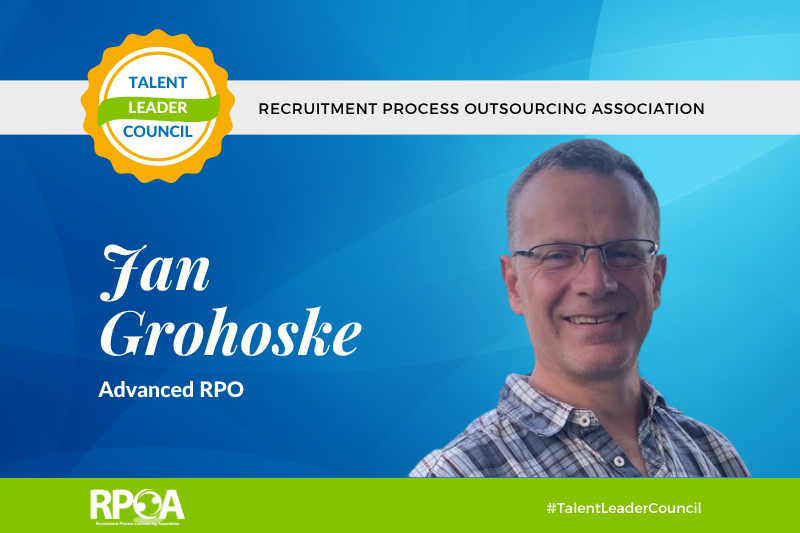
This article is based on an edited conversation from the Talent Leader Council interview series, featuring Jan Grohoske, Senior Director of Digital Strategy and Implementation at Advanced RPO and a Talent Leader Council contributor. The interview was conducted by Lamees Abourahma, CEO of the Recruitment Process Outsourcing Association.
Key Takeaways for Talent Acquisition Leaders
- AI adoption in Recruitment Process Outsourcing (RPO) requires governance frameworks, not just technology deployment
- Process integrity and structured data are prerequisites for successful AI integration
- RPO providers are increasingly expected to serve as AI advisors, not just delivery partners
- Fragmented pilots and poor change management are primary barriers to scaling AI impact
- Candidate experience and fraud prevention must be designed into AI-enabled workflows from the outset
AI Expertise Has Become a Core Expectation in Recruitment Process Outsourcing
The role of Recruitment Process Outsourcing (RPO) providers is shifting in response to increased complexity in talent acquisition. The 2026 RPO Buyer Trends Study shows that AI consulting and expertise now rank among the top three expectations from enterprise buyers.
RPOA: Why is AI expertise becoming a primary expectation for Recruitment Process Outsourcing (RPO) partners?
Grohoske: Talent leaders are under pressure to do more with fewer resources while managing rising hiring demand. AI presents an opportunity to scale recruiting operations, reduce manual effort, and improve speed, but the volume of available tools has created confusion. Organizations are looking for partners who can distinguish signal from noise and guide practical application.
Rather than seeking tools alone, organizations are prioritizing outcomes such as improved sourcing precision, faster screening, and enhanced candidate engagement. This shift reflects a broader evolution in Recruitment Process Outsourcing (RPO), where providers are expected to translate emerging technologies into measurable business value.
“It’s really about helping companies turn AI into real recruiting value, not just checking the box on having a tool,” said Jan Grohoske, Senior Director of Digital Strategy and Implementation at Advanced RPO.
For talent leaders, this signals a transition from vendor selection to capability building, with Recruitment Process Outsourcing (RPO) providers acting as strategic advisors.
Process Maturity Determines AI Success in Talent Acquisition
Despite increased investment in artificial intelligence, many organizations are not realizing expected outcomes. A key reason is the misalignment between technology and underlying recruiting processes.
RPOA: How does process design impact the effectiveness of AI in Recruitment Process Outsourcing (RPO)?
Grohoske: AI amplifies existing conditions within a recruiting function. If processes are fragmented or data is unstructured, AI will scale those inefficiencies rather than resolve them. Successful implementation requires a foundational review of workflows, systems, and data integrity before introducing automation.
This aligns with long-standing principles in Recruitment Process Outsourcing (RPO). Technology cannot compensate for flawed processes. Instead, it requires a structured environment where workflows are clearly defined and consistently executed.
The implications are significant. Organizations relying on disconnected systems or manual workarounds, such as spreadsheet tracking outside the applicant tracking system, are unlikely to achieve meaningful AI outcomes. Clean, centralized data is essential for enabling intelligent automation and accurate decision-making.
“If you have a bad process, AI will multiply those issues faster than humans ever could,” Grohoske noted.
For talent acquisition leaders, this reinforces the need to prioritize process redesign as a prerequisite to AI adoption.
Why AI Pilots Fail to Scale Across Recruitment Functions
While many organizations have initiated AI pilots, fewer have successfully scaled these initiatives across the enterprise. The gap between experimentation and execution remains a persistent challenge.
RPOA: Why are organizations struggling to translate AI pilots into enterprise-level impact?
Grohoske: Pilots are often conducted in isolation without integrating into broader workflows. Without redesigning end-to-end processes or aligning stakeholders, the impact remains limited. Additionally, lack of clarity around success metrics and insufficient change management can undermine adoption.
The 2026 RPO Buyer Trends Study reinforces this challenge. While 76 percent of employers report time savings from AI, the underlying data shows more nuance in how value is being realized. Specifically, 44 percent of employers report that AI saves recruiters two to five hours per week, while an additional 32 percent report savings of more than five hours weekly. Additionally, 75 percent of recruiting teams indicate that their workloads have been reduced, with 29 percent describing that reduction as significant and 46 percent as moderate. Despite these gains, many organizations remain early in their maturity journey, with fragmented implementations limiting broader transformation.
Effective scaling requires more than technical integration. It demands alignment across recruiters, hiring managers, and leadership, along with clear definitions of success and accountability.
“This is not just dropping a new tool into the process. It is a full change management effort,” Grohoske explained.
For Recruitment Process Outsourcing (RPO) partnerships, this creates an opportunity to lead enterprise-wide transformation rather than isolated innovation.
Governance and Risk Management Are Now Central to AI Strategy
As AI adoption accelerates, risk considerations are becoming central to talent acquisition strategy. Organizations are increasingly concerned about bias, regulatory compliance, and reputational exposure.
RPOA: How should Recruitment Process Outsourcing (RPO) partners support responsible AI adoption?
Grohoske: RPO providers are uniquely positioned to guide governance because they have already evaluated and piloted many AI tools internally. This experience enables them to establish frameworks for compliance, bias mitigation, and decision documentation that can be adapted for client environments.
Governance is not a one-time activity. It requires ongoing collaboration between talent acquisition, legal, and IT functions. Transparent processes, clear documentation, and consistent oversight are essential to maintaining trust and compliance.
Candidate experience is also a critical component of responsible AI use. Organizations must communicate how AI is used in the hiring process and ensure that automation enhances, rather than detracts from the candidate journey.
“Transparency about where AI is used and what candidates can expect is essential to maintaining trust,” Grohoske emphasized.
This reflects a broader shift in Recruitment Process Outsourcing (RPO), where ethical and operational governance are becoming as important as efficiency gains.
AI Is Creating New Risks in Candidate Authenticity and Fraud
One of the most emerging challenges in AI-enabled recruiting is the rise of candidate fraud. The 2026 RPO Buyer Trends Study indicates that 22 percent of employers identify cyber-related fraud as a top hiring challenge, while 54 percent believe candidates intentionally misrepresent themselves. An additional 32 percent of employers attribute misrepresentation to the pressure created by automated or impersonal hiring processes, highlighting that both deliberate fraud and systemic process design contribute to the issue.
RPOA: How is AI contributing to new forms of candidate fraud, and how should organizations respond?
Grohoske: AI tools are increasingly being used by candidates to enhance or misrepresent their qualifications. In some cases, this includes deliberate manipulation of resumes or attempts to exploit automated screening systems. Organizations must adapt their screening processes to detect and mitigate these risks.
Solutions include digital identity verification tools, enhanced screening methodologies, and more rigorous interview practices that focus on real-world experience rather than theoretical knowledge.
Importantly, this is not solely a technology challenge. It also requires changes to interview design and evaluation frameworks to ensure authenticity.
“AI is being used on both sides of the hiring process, which means organizations need to rethink how they validate candidate credibility,” Grohoske stated.
For talent leaders, this introduces a new dimension of risk management that must be integrated into Recruitment Process Outsourcing (RPO) strategies.
Conclusion
Artificial intelligence is no longer a future consideration in talent acquisition. It is an operational reality that is reshaping how organizations attract, assess, and hire talent. However, as the 2026 RPO Buyer Trends Study highlights, the challenge is not adoption alone but responsible and effective implementation.
The insights from Jan Grohoske underscore a critical shift in Recruitment Process Outsourcing (RPO). Success will not be defined by the volume of AI tools deployed, but by how thoughtfully they are integrated into processes, governed, and aligned to business outcomes.
For talent acquisition leaders, the path forward requires a balanced approach. This includes investing in process maturity, establishing governance frameworks, and leveraging Recruitment Process Outsourcing (RPO) partners as strategic advisors.
As the RPOA continues to convene industry leaders and advance evidence-based insights, one conclusion is clear. The organizations that will lead in this new era are those that approach AI with discipline, clarity, and purpose.



-min-1-1.jpeg)