Organizations have entered a new chapter in talent acquisition. The challenge is no longer simply hiring the right people faster or at a lower cost. Talent leaders are navigating a far more complex environment, balancing AI adoption, workforce transformation, cyber risk, and increasing pressure to demonstrate measurable business value from every investment.
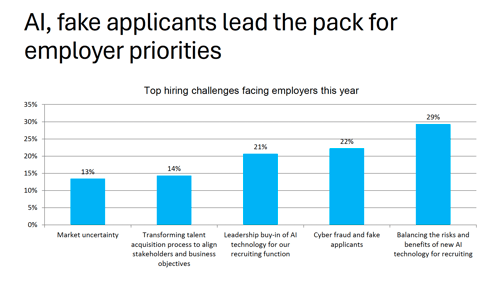
The findings of the RPOA 2026 Buyer Study reflect this shift. Employers identified balancing the risks and benefits of AI (29%), cyber fraud and fake applicants (22%), and leadership buy-in for AI (21%) as more pressing concerns than market uncertainty itself. These priorities signal a broader evolution in how organizations view Recruitment Process Outsourcing (RPO). Buyers increasingly expect their RPO providers to deliver strategic expertise, technology guidance, workforce intelligence, and business insight alongside recruiting execution.
These themes emerged consistently during a recent discussion I moderated with senior talent leaders from healthcare, insurance brokerage, and human capital advisory organizations. While the conversation began around future industry priorities, it quickly became clear that the questions keeping today's talent leaders awake at night are remarkably consistent across industries.
Editor's Note: This article synthesizes insights from a conversation with Ryan Henning, Associate Vice President, Talent Acquisition at OU Health; Rob Navarrete, Global Talent Acquisition and Transformation Leader at WTW; and Malvika Jethmalani, HCM advisor and CHRO for PE-backed Organizations. Their perspectives have been editorially curated alongside findings from the RPOA 2026 Buyer Study to explore how buyer expectations for Recruitment Process Outsourcing are evolving.
Key Takeaways for Talent Acquisition Leaders
- Organizations are redefining the value of Recruitment Process Outsourcing from recruiting capacity to business capability.
- AI investments are exposing operating model challenges that require organizational redesign, not simply technology implementation.
- Candidate fraud has become an enterprise risk that demands stronger governance, verification, and technology capabilities.
- Talent acquisition leaders increasingly expect RPO providers to bring proven market intelligence, not experimental solutions.
- The future of Recruitment Process Outsourcing will be defined by strategic advisory capabilities as much as recruiting excellence.
The Conversation Has Shifted from Cost to Capability
Cost discipline remains a reality for every executive team. Boards continue asking leaders to reduce operating expenses while maintaining growth, productivity, and hiring quality. Yet the discussion among today's talent leaders has moved well beyond reducing recruiting spend.
Rob Navarrete described the challenge succinctly. Organizations are simultaneously being asked to rethink internal recruiting functions, optimize supplier relationships, and modernize talent acquisition without disrupting business performance.
As he noted, "The intention is not to impact our quality in a negative way. We’re asked to change the wheels on the race car while we're driving it."
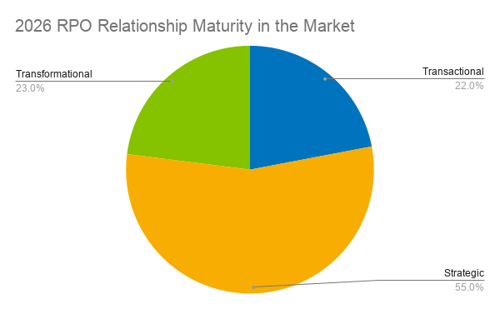
That perspective reflects a broader market shift. According to the RPOA 2026 Buyer Study, more than half of organizations now characterize their RPO relationship as strategic, while nearly one in four describe it as transformational. Buyers increasingly expect providers to contribute to workforce planning, technology modernization, and broader business outcomes rather than simply managing recruiting operations.
Source: 2026 Lighthouse Research & Advisory, RPO Buyer Trends Study
This represents an important evolution for the RPO industry. Recruiting execution remains essential, but buyers are increasingly evaluating partners on their ability to help organizations solve business challenges.
AI Is Exposing Operating Model Challenges
Artificial intelligence dominated our discussion, but not in the way many industry conversations approach it.
None of the leaders questioned whether AI belongs in talent acquisition. Instead, the discussion focused on a more practical question: How do organizations realize measurable business value from AI investments?
Malvika Jethmalani observed that many organizations have already completed the first phase of AI adoption. They have introduced generative AI tools, trained employees, and launched isolated pilots. What many have not yet accomplished is redesigning work itself.
Organizations are now asking harder questions. How should recruiting teams operate differently? Which decisions should remain human? Which activities should be automated? How should recruiters be reskilled? How should success be measured?
As Jethmalani explained, organizations are discovering that productivity gains alone do not constitute transformation. Sustainable ROI requires rethinking operating models, workforce capabilities, and organizational design.
Ryan Henning offered a complementary perspective from healthcare. Technology investments only create value when they become embedded in recruiting workflows. AI should improve recruiter effectiveness without diminishing the candidate or hiring manager experience, particularly for leadership and highly specialized positions where human judgment remains essential.
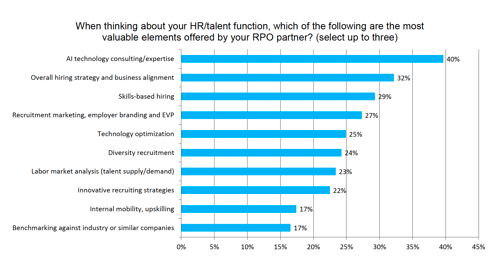
The 2026 RPOA Buyer Study executive briefing, titled "From Execution to Intelligence," reinforces these observations. AI technology consulting has emerged as one of the most valuable services buyers expect from their RPO providers, alongside overall hiring strategy and business alignment.
Source: 2026 Lighthouse Research & Advisory, RPO Buyer Trends Study
Taken together, these perspectives suggest a significant evolution in buyer expectations. Organizations are no longer asking whether AI should be implemented. They are asking how AI changes workforce design, recruiter capabilities, governance, and business performance.
"Companies have experimented with AI. Now they're asking, 'Where is the ROI?' That requires redesigning work, not simply deploying more technology."
Malvika Jethmalani
Candidate Fraud Is Becoming an Enterprise Risk
Perhaps the most striking shift in priorities was the attention given to candidate fraud.
Source: From Execution to Intelligence: How AI Is Redefining the RPO Partnership
For years, talent acquisition leaders focused primarily on attracting qualified candidates. Today, many are equally concerned with verifying that candidates are who they claim to be.
Navarrete described the challenge facing many enterprise recruiting organizations. As application volumes increase and AI-generated resumes become more sophisticated, distinguishing legitimate candidates from fraudulent ones has become increasingly difficult.
"Fraud continues to be an enormous topic for us. This is what's keeping me up at night."
Henning echoed similar concerns, particularly in technology recruiting, where organizations increasingly encounter applicants who misrepresent their identities, qualifications, or work products through AI-assisted applications.
These concerns closely mirror the RPOA Buyer Study findings. Candidate fraud now ranks among employers' leading hiring challenges, while 58 percent of buyers want their RPO provider to support cyber risk and candidate fraud prevention. Compliance, risk, and fraud detection also rank as the highest-priority area for AI investment in talent acquisition over the next 12 to 18 months.
This signals another important shift. Fraud prevention is no longer simply a recruiting issue. It is becoming a business governance issue that requires coordination across talent acquisition, technology, legal, compliance, and cybersecurity.
Buyers Want Advisors, Not Vendors
One theme surfaced repeatedly throughout our discussion.
Talent acquisition leaders increasingly expect their RPO partners to anticipate market changes rather than react to them.
They want providers that understand emerging technologies, monitor evolving labor markets, identify proven practices across industries, and help clients avoid costly mistakes.
Henning emphasized the importance of market intelligence. Organizations expect RPO partners to share what they are seeing across clients and industries and translate those insights into practical talent strategies.
"The expectation today is that RPO partners help shape talent strategy by bringing market insight, technology expertise, and proven approaches that organizations can apply with confidence."
Navarrete expanded on that expectation, observing that buyers increasingly want providers to arrive with demonstrated use cases rather than asking clients to become early adopters.
"We expected them to be there long ago. We expect them to have already proven use cases."
The Buyer Study points in the same direction. Buyers increasingly value AI expertise, strategic hiring alignment, innovative recruiting strategies, workforce planning, and technology optimization alongside traditional recruiting capabilities.
For RPO providers, this represents both an opportunity and a challenge. Competitive differentiation will increasingly depend on helping clients make better business decisions, not simply filling open requisitions.
What This Means for the Future of Recruitment Process Outsourcing
The discussion and the RPOA 2026 Buyer Study point to the same conclusion: buyer expectations are evolving faster than many organizations realize.
Recruiting excellence remains foundational. Organizations will always value quality hiring, speed, and operational execution. However, execution alone is no longer sufficient.
Today's talent acquisition leaders are looking for partners who can help them navigate AI transformation, redesign recruiting operating models, mitigate emerging risks, strengthen workforce planning, and connect talent strategy to broader business priorities.
That evolution represents a defining opportunity for the Recruitment Process Outsourcing industry.
Providers that continue to compete primarily on recruiting capacity may find it increasingly difficult to differentiate. Those that invest in advisory capabilities, AI expertise, workforce intelligence, and strategic consulting will be better positioned to become trusted partners in enterprise workforce transformation.
As these conversations continue across the industry, one message is becoming increasingly clear: the future value of Recruitment Process Outsourcing will be measured not only by how efficiently organizations hire talent, but by how effectively their partners help them build more resilient, intelligent, and adaptable talent strategies.